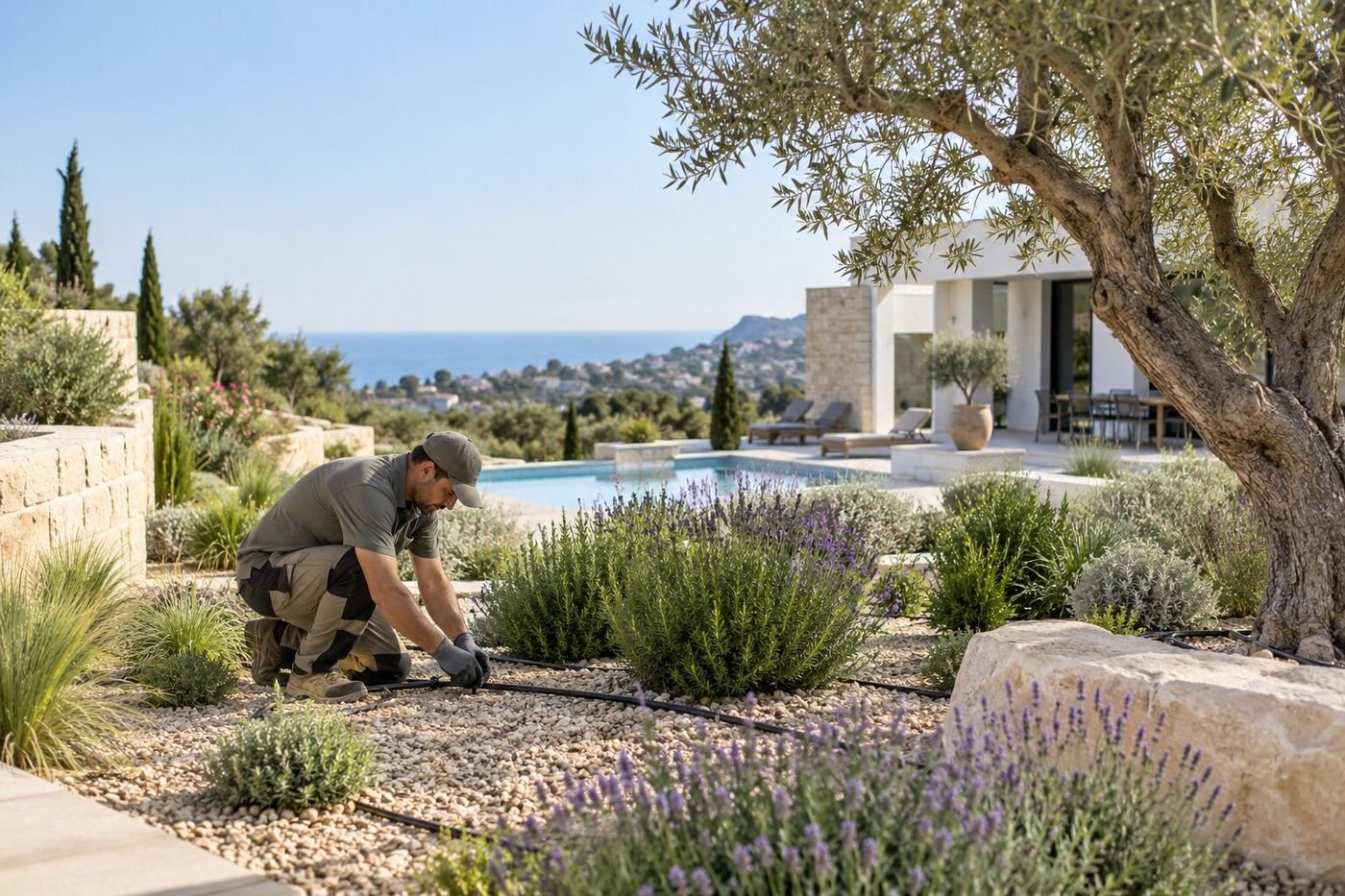
Garden Landscaping in Cyprus: Costs, Irrigation, Plants and Hiring a Landscaper
Plan a Cyprus garden around heat, irrigation, suitable planting and realistic costs, with practical questions to ask before hiring a landscaper.
Creating a garden in Cyprus is not simply a matter of copying a design that works in Britain. Long, hot summers, intense sun, exposed coastal plots, variable soil and the cost of irrigation all affect what should be planted and how the garden should be built.
A successful Cyprus garden begins with the way the property will actually be used. A holiday home may need a robust, low-maintenance scheme that can survive between visits. A permanent home may justify more varied planting and regular care. A rental property needs safe paths, straightforward maintenance and plants that do not create constant debris around a pool.
This guide explains the decisions that influence landscaping costs, how to brief a contractor, what to ask about irrigation and which practical checks to complete before work starts.
Start with the site, not the plant catalogue
Before requesting prices, record the conditions across the plot. A landscaper should consider sun and shade, prevailing wind, slopes, drainage, existing trees, soil depth, access and the position of underground services.
Walk through the garden at different times of day and note:
- Areas receiving full summer sun
- Shade cast by the house, walls and neighbouring buildings
- Places where rainwater collects or runs towards the property
- Exposed corners affected by coastal wind or salt
- Existing plants that are healthy without excessive watering
- Routes used by children, pets, guests and maintenance workers
- Pool equipment, drains, inspection covers and utility routes
These observations prevent expensive mistakes. A beautiful shade plant will struggle in reflected heat beside a pale wall, while a tree planted too close to a pool can create years of leaf litter and root concerns.
What determines the cost of landscaping in Cyprus?
There is no responsible universal price per square metre. Two gardens of the same size can require completely different budgets. The useful approach is to understand what drives the quotation and compare contractors against the same written brief.
The main cost factors include:
- Clearance, excavation and disposal
- Access for machinery and deliveries
- Retaining walls, steps and level changes
- Drainage and soil improvement
- Paving, gravel, edging and other hard landscaping
- Irrigation zones, pipework, controllers and filters
- Plant size and maturity
- Lighting and electrical work
- Poolside finishes and safety requirements
- Establishment visits and continuing maintenance
Ask for labour, materials, plants, irrigation and waste removal to be separated where practical. A single total makes it difficult to compare specifications or understand what will be omitted if the budget changes.
Large specimen plants create an immediate effect but cost more to buy, transport and establish. Smaller plants generally reduce the initial price and may adapt more easily, but the design needs suitable spacing and patience. Ask the landscaper to explain where maturity is worth paying for and where younger planting is sensible.
Set a realistic landscaping brief
A clear brief improves both the design and the quotation. Include the property location, approximate area, photographs, intended use, maintenance expectations and your priorities.
Specify whether you need:
- A complete redesign or selected improvements
- Hard landscaping and construction
- Planting only
- Automatic irrigation
- Garden lighting
- Poolside work
- Screening from neighbours
- Child-friendly or pet-friendly planting
- Space for dining, play or outdoor cooking
- Ongoing maintenance after installation
If you have a fixed budget, state it as a range and ask what can be delivered properly within it. Cutting irrigation, drainage or ground preparation to preserve decorative items can produce a garden that photographs well on completion but deteriorates quickly.
Irrigation should be designed, not improvised
Water is one of the most important design considerations in a Cyprus garden. An automatic system can make watering more consistent, but it does not remove the need for sensible planting or regular inspection.
Drip irrigation is commonly suitable for beds, shrubs and trees because water can be delivered close to the root zone. Different planting areas may require separate zones. New planting usually needs a different establishment schedule from mature drought-tolerant shrubs, while lawns have different requirements again.
Ask the contractor to document:
- The number and purpose of irrigation zones
- Pipe and emitter specifications
- Controller location and programming
- Filtration and pressure requirements
- Isolation valves
- How the system will be flushed and serviced
- Seasonal adjustments
- What happens during a leak or power failure
After installation, request a simple plan showing the main pipe routes and valves. Photograph concealed pipework before it is covered. This makes later repairs far easier.
The Cyprus Water Development Department publishes information on water management and conservation. Homeowners should also follow any current local restrictions or supply guidance rather than assuming an irrigation schedule can remain unchanged throughout the year.
Choose plants for the actual microclimate
“Mediterranean” is not a complete planting specification. Conditions vary between coastal Paphos, humid or exposed areas around Limassol, inland Nicosia, Larnaca and elevated villages. Soil, altitude, wind and reflected heat can matter as much as the regional label.
Useful characteristics for lower-maintenance planting include:
- Tolerance of heat and periods of dry weather once established
- Suitability for the available soil and drainage
- Resistance to local wind exposure
- A mature size appropriate to the space
- Limited debris near pools and drains
- No dangerous thorns or toxicity where children and pets play
- A manageable pruning schedule
Olive, carob, pomegranate, citrus, rosemary, lavender, myrtle and other climate-suitable plants may feature in Cyprus gardens, but selection should never be based on a list alone. Citrus, for example, still needs appropriate feeding, irrigation and pest monitoring. Ask a knowledgeable local landscaper or nursery to match the variety to your site. For layout ideas before you brief anyone, see our Cyprus garden design guide.
Avoid filling every gap immediately. Good design allows for mature spread, access and air movement. Overplanting increases cost, water demand and future pruning.
Lawn, artificial grass or a planted alternative?
A conventional lawn can provide a comfortable family area, but in Cyprus it may require substantial irrigation, mowing, feeding and seasonal care. Before choosing it, calculate the area genuinely needed rather than treating grass as the default surface.
Artificial grass reduces mowing and irrigation but is not maintenance-free. It can become hot in direct sun, needs suitable drainage and preparation, and may require cleaning—especially where pets use it. Poorly prepared bases can sink, smell or hold water.
Alternatives include gravel with defined paths, ground-cover planting, shaded seating areas and smaller areas of lawn combined with drought-aware beds. Compare comfort, heat, drainage, appearance, expected life and end-of-life disposal rather than deciding on installation price alone.
Plan carefully around swimming pools
Poolside landscaping must balance appearance with safety and maintenance. Confirm that paving is suitable for wet areas, properly laid and compatible with the pool structure and drainage.
Think about:
- Slip resistance under wet bare feet
- Surface temperature in strong sun
- Drainage away from buildings and pool equipment
- Roots near pipework and structures
- Leaves, flowers and fruit entering the water
- Access to pumps, filters and covers
- Lighting positions and electrical safety
- Clear sightlines where children use the pool
Electrical work and alterations affecting the pool or structure should be handled by appropriately authorised professionals. Ask who is responsible for each element instead of assuming the landscaper personally completes every trade.
Compare written quotations properly
Invite two or three suitable businesses to quote against the same scope. The cheapest total is not necessarily the lowest final cost if quantities, preparation or disposal are missing.
A useful quotation should state:
- Areas and measurements
- Ground preparation and soil specification
- Plant names, sizes and quantities
- Paving, gravel and edging specifications
- Irrigation components and zones
- Waste removal
- VAT treatment
- Start date and estimated duration
- Payment stages
- Exclusions and provisional items
- Establishment care and plant-replacement terms
If a plant allowance is included, request the proposed schedule before agreeing. “Plants and shrubs included” does not tell you the quantity, size or quality.
Check the landscaper before paying a deposit
Ask for the full legal identity of the person or company supplying the work. Check that the quotation, invoice and payment details are consistent. For construction-heavy landscaping, clarify whether regulated contractor involvement, design input or permissions are required.
Request recent examples with similar conditions—not only generic portfolio photographs. When speaking to previous customers, ask whether drainage, irrigation and planting remained successful after the first summer, how defects were handled and whether the final price matched the agreed scope.
Also ask for current insurance evidence relevant to the work. Where subcontractors handle electrical, structural, pool or specialist irrigation elements, establish who appoints and supervises them.
Use a written agreement for meaningful work. It should record the scope, drawings, materials, payment stages, responsibilities, variation process, access, completion checks and what happens if plants fail during an agreed establishment period.
Avoid paying too much too early
A reasonable deposit may be required for ordered plants, materials or mobilisation. Later payments should correspond to identifiable progress.
Before each payment:
- Inspect the completed stage
- Confirm specified materials and plants are present
- Record incomplete or defective work
- Approve variations in writing
- Obtain an invoice or receipt
Do not pay the full balance before irrigation testing, cleaning, snagging and handover information are complete.
Maintenance is part of the design
Ask what the garden will require weekly, monthly and seasonally. A useful handover should explain irrigation changes, pruning, feeding, pest observation and the establishment needs of new plants.
If the property is frequently empty, decide who will notice a blocked emitter, failed controller or damaged plant. Remote controllers can be useful, but they do not replace physical inspection.
Agree whether the installer will return after several weeks and after the first demanding season. Record which plant failures are covered, for how long and under what watering or maintenance conditions.
Common landscaping mistakes in Cyprus
- Designing for the first photograph rather than mature growth
- Installing one irrigation schedule for every plant
- Ignoring drainage because summer ground looks dry
- Choosing plants without considering wind or salt exposure
- Placing high-debris trees beside a pool
- Underestimating maintenance at a holiday property
- Comparing quotations with different specifications
- Paying before irrigation and drainage are tested
- Starting construction-heavy work without checking permissions or professional requirements
- Failing to keep a plan of concealed pipes and cables
Questions to ask a Cyprus landscaper
- Which parts of the garden receive the greatest heat, wind and water stress?
- How will drainage be handled during intense rain?
- Why are these plants suitable for this specific site?
- How many irrigation zones are proposed and why?
- What preparation is included beneath paving and planted areas?
- Which elements will be subcontracted?
- What maintenance will be required after handover?
- What is excluded from the quotation?
- What evidence and drawings will I receive on completion?
- Can I speak to a recent customer whose garden has passed through at least one summer?
The bottom line
Good garden landscaping in Cyprus combines design with water planning, correct preparation and realistic maintenance. Begin with the property’s microclimate, compare detailed specifications and appoint a business with relevant local work—not simply the most attractive concept image.
Browse landscapers in Cyprus and use the TrustedTradesCyprus directory to build a shortlist. Verification can support your research, but you should still check the contractor, quotation, insurance and written agreement for your particular project.
Frequently asked questions
How much does garden landscaping cost in Cyprus?
There is no reliable price per square metre. Clearance, access, retaining walls, drainage, hard landscaping, irrigation, plant size and lighting all change the total. Ask two or three landscapers to price the same written brief with labour, materials, plants and irrigation shown separately.
Is drip irrigation worth it in a Cyprus garden?
For beds, shrubs and trees it usually is, because water goes straight to the root zone. Ask for separate zones for different planting, a documented controller and filter set-up, and a plan of the pipe routes before they are covered.
What plants suit a low-maintenance Cyprus garden?
Plants that tolerate heat and dry spells once established, suit the soil and wind exposure, and stay a sensible size. Olive, carob, pomegranate, rosemary, lavender and myrtle often feature, but a local landscaper or nursery should match varieties to your plot.
Should I choose a lawn or artificial grass in Cyprus?
A real lawn needs substantial watering, mowing and feeding through a Cyprus summer. Artificial grass cuts that work but still needs cleaning and can get hot in direct sun. Many gardens use a smaller lawn area combined with planted beds and gravel.
Further guidance
Looking for a local professional?
Browse the directory and compare the information each business provides before making your shortlist.
Browse the directory