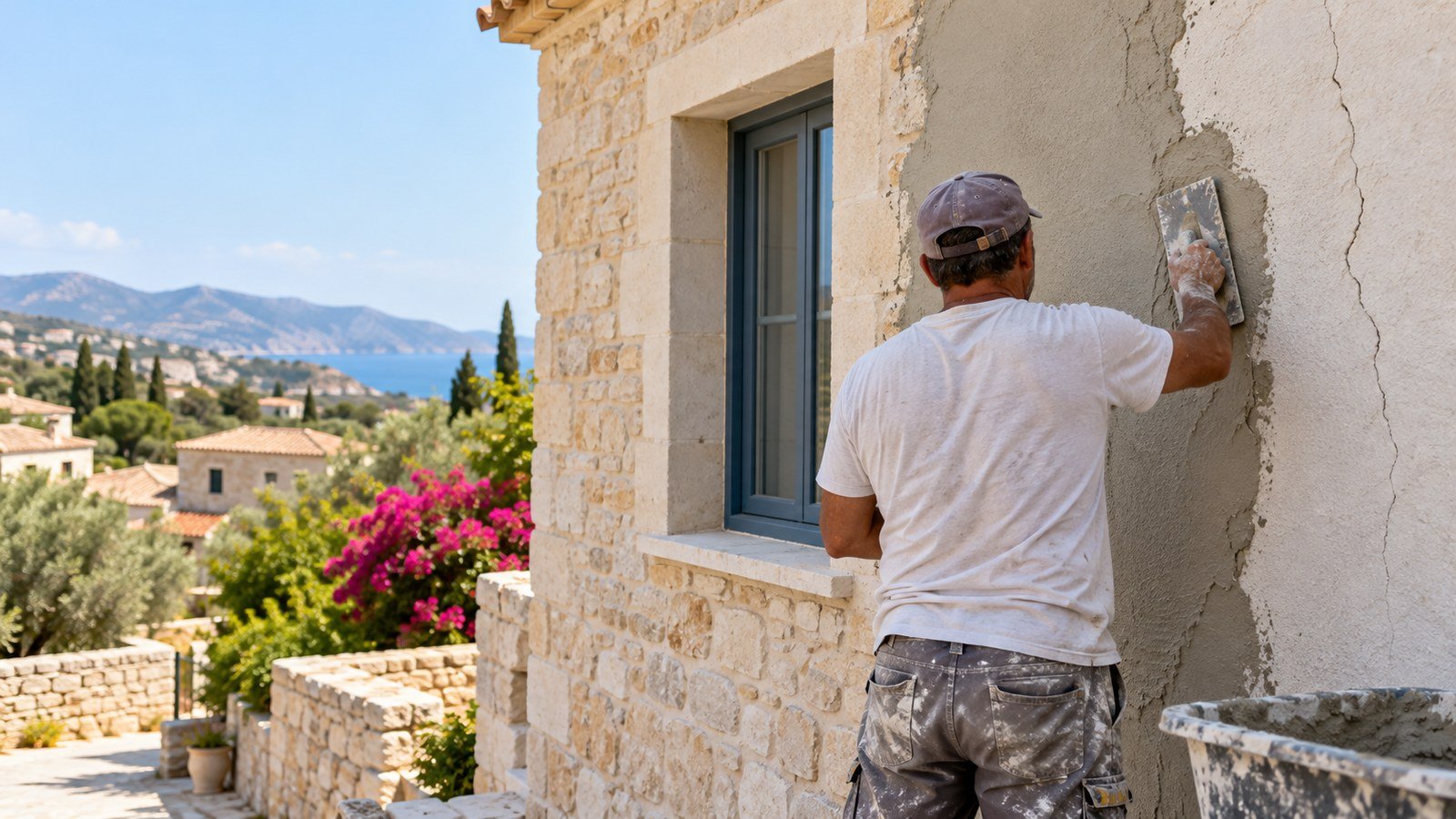
Plastering in Cyprus: Cracked Render, Damp Walls and Hiring the Right Plasterer
Why render cracks and walls turn damp in Cyprus homes, which plaster suits which wall, and what to ask before you accept a plastering quotation.
The short answer: most Cyprus homes are finished in cement render over a concrete frame and block walls. Fine cracks are common and usually cosmetic, but cracks that are wide, stepped or keep coming back need an engineer before a plasterer. Damp needs a diagnosis before any replastering, because condensation, rising damp and water coming through the wall each need a different fix. Get every quotation against the same written brief, and check whether the 2026 energy upgrade grant could pay towards insulating render before you start.
Plastering looks simple from the outside. A wall is cracked or stained, someone comes along, makes it smooth again and the job is done. In Cyprus the real work is in deciding why the wall failed in the first place. If that question is skipped, new plaster often fails in the same place within a year or two and you pay twice.
This guide is written for homeowners, holiday home owners and anyone renovating in Cyprus. It covers the words you will hear, the problems behind most plastering jobs, timing, money and what a good plasterer will tell you before picking up a trowel. For a list of plasterers already on the platform, see our plasterers in Cyprus page.
Plaster, render and the words you will hear
Plasterers in Cyprus will often use the Greek word σοβάς (sovas) for both inside plaster and outside render. It helps to know the main types so that two quotations can be compared properly.
- External cement render. The standard finish on most Cypriot houses and apartment blocks, usually applied in two or three coats over concrete and block, then painted or finished with a coloured top coat.
- Internal plaster. Cement or gypsum based plaster on inside walls and ceilings. Gypsum sets quickly and gives a smooth surface for painting, but it does not like persistent moisture.
- Skim coat. A thin finishing layer over sound plaster to give a smooth surface before decorating.
- Lime plaster and render. The traditional finish on old stone and mud brick village houses. It lets moisture move out of the wall rather than trapping it.
- Thermal or insulating systems. Insulation boards fixed to the outside walls and finished with a reinforced render, or a render with insulating properties. These are often part of an energy upgrade rather than a repair.
- Mesh. Fibreglass mesh bedded into render, especially where concrete meets block and around windows. It is one of the most important details in Cyprus and one of the easiest to leave out.
Why render cracks in Cyprus
Most houses here have a reinforced concrete frame (columns, beams and slabs) filled in with clay or concrete blocks. Concrete and block expand and move differently in heat. Add strong summer sun, big swings between day and night temperatures, and render that dried too fast when it was applied, and cracks follow familiar lines: along the edges of beams and columns, at the corners of windows and doors, and as fine random crazing across sunny walls.
Coastal homes in Larnaca, Limassol, Paphos and the Ayia Napa area also deal with salty air, which can stain and break down finishes faster on walls facing the sea.
Use this table as a first guide, not a diagnosis.
| What you see | Likely cause | Who to call first |
|---|---|---|
| Fine crazing across a sunny wall | Render dried too quickly or a weak top coat | Plasterer or painter |
| Straight cracks along beams, columns or slab edges | Movement between concrete frame and block infill, often without mesh | Plasterer, ideally one who uses mesh across the joint |
| Cracks from the corners of windows and doors | Stress at openings, missing mesh or lintel movement | Plasterer, with an engineer if the crack is widening |
| Wide, stepped or diagonal cracks, or cracks that reopen after repair | Possible structural movement or foundation issue | Civil engineer before any plastering |
| Render that sounds hollow when tapped or comes away in sheets | Poor bond to the wall, often from water getting behind it | Plasterer, after finding where the water comes from |
A simple habit helps: photograph each crack with a coin or tape measure beside it and note the date. A few months of photos tell an engineer or plasterer far more than a single visit.
Damp walls: find the cause before you replaster
Many homes in Cyprus are built for heat and are poorly insulated and ventilated for winter. Three kinds of damp come up again and again, and each one needs a different answer.
Condensation
Black mould in corners, behind wardrobes and on north facing walls, worse in winter and in rooms that are closed up for long periods. Holiday homes left shut between visits are a common example. The cause is warm, moist air meeting a cold wall. New plaster will not fix it. Ventilation, heating, dehumidifying and sometimes insulation will.
A quick home test: tape a square of kitchen foil tightly to the damp area and leave it for two days. Moisture on the room side of the foil points to condensation. Moisture underneath points to water coming through or up the wall.
Rising damp
A tide mark low on ground floor walls, salts crystallising on the surface and paint bubbling near the floor. It is most common in older village houses without a damp proof course and where outside ground levels or paving sit higher than the floor inside. Covering it with cement plaster often pushes the moisture higher up the wall.
Penetrating damp
Patches that appear or grow after rain, often below cracked render, leaking flat roofs, balconies, blocked gutters or badly sealed windows. The source has to be fixed first. Our pages on damp proofing and waterproofing in Cyprus and roof repair in Cyprus cover the specialists for that part of the job.
Be careful with anyone who offers to replaster a damp wall without asking where the water is coming from. That is the most common way to pay for the same wall twice.
Old stone village houses need a different approach
Traditional houses in the Troodos and Paphos villages, and older properties across the island, were built from stone, mud brick and lime. These walls were designed to absorb and release moisture. When they are covered with hard cement render, the moisture has nowhere to go, so it comes out inside as damp, flaking paint and crumbling plaster.
If you are restoring a stone house, ask any plasterer:
- Have you worked with lime plaster or lime render before, and can I see a recent example?
- Will existing cement render need to come off, and how will you protect the stone underneath?
- How long does lime need to cure, and how will you protect it from sun and rain while it does?
Some village properties are listed or sit in protected areas, so check with your architect or the local authority before changing the outside appearance.
Timing: when to plaster and render
Spring and autumn are usually the best seasons for external render in Cyprus. In high summer, render can dry before it has cured, which causes exactly the cracking you are trying to fix. A careful plasterer will work on shaded walls, start early in the morning and mist the surface so it cures slowly. In winter, heavy rain can wash out fresh render, so work needs protecting.
Inside, timing matters less, but new plaster still needs to dry properly before painting. Painting too soon traps moisture and causes peeling. Ask your plasterer how long to wait before decorating.
Insulating render and the 2026 energy upgrade grant
If you are going to scaffold the house and render the outside anyway, it is worth asking whether insulating the walls at the same time makes sense. It costs more than a simple repair, but it can make a real difference to summer heat and winter damp.
The Cyprus government's Save and Upgrade Homes 2026 scheme includes thermal insulation among its eligible measures. Based on the published announcement:
- Applications open at 9am on 20 October 2026 and close at 11.59pm on 30 December 2026, or earlier if the budget runs out. Applications are dealt with in order of submission.
- The scheme is for eligible existing homes owned by individuals. The published criteria include an existing domestic electricity account in the applicant’s name and qualifying age/permit conditions; check the scheme guide for the exact route that applies to the property.
- An initial Energy Performance Certificate issued on or after 15 May 2026 by an eligible expert is required before applying. Works must meet the scheme’s sequencing and technical rules; confirm these before starting or committing to the project.
- The published scheme describes support of up to €32,000 for Category A and €24,000 for Category B, subject to eligibility and the required energy performance outcome. Insulation is only one part of a qualifying package; do not assume render or insulation alone will qualify.
Do not start work you hope to claim for until you have read the official guide and understood the order of steps. The scheme details can change, so treat the figures above as a starting point and confirm them on the official funding programmes portal.
VAT on plastering work
Some qualifying renovation work on private homes may be eligible for a reduced VAT rate, but the applicable rate and conditions depend on the precise work, property and current tax rules. Ask the contractor to state the VAT treatment and basis on the quotation, then confirm uncertain cases with the Cyprus Tax Department or an accountant.
Ask every plasterer whether they are VAT registered, which rate they have applied and why. A quotation that looks cheaper only because it assumes a reduced rate that may not apply is not really cheaper. For a large project, confirm the position with your accountant.
Licences and who you are hiring
Cyprus has a registration and licensing framework for building and civil engineering contractors. Whether it applies to a particular plastering job can depend on the scope and contract, so do not assume every standalone repair has the same requirement. For larger renovation or construction work, ask who the registered contractor is and check the current rules with the Contractors Council or a Cyprus construction professional.
For a standalone plastering job, ask what registration the business holds, who the contract will be with and whether they carry insurance for the work. Our guide on how to check a builder in Cyprus before hiring walks through identity, licence and insurance checks step by step.
What a good plastering quotation includes
Ask each plasterer to quote against the same written brief, with photos and wall measurements if you have them. A useful quotation should cover:
- Which walls and ceilings, and the area in square metres
- How much loose or hollow render will be removed, and what happens if more is found
- How cracks will be treated, including mesh across concrete and block joints
- Primers or bonding agents, the plaster or render system and the brand
- Number of coats, overall thickness and the finish texture
- Scaffolding or access equipment, and who supplies it
- Protection of floors, windows, gardens and pools
- How the new render will be cured and protected
- Making good around windows, sockets and pipes
- Whether painting is included, and if not, how long to wait before painting
- Waste removal and clean up
- VAT rate, start date, expected duration and payment stages
Our free quote comparison tool lets you put quotations side by side so the gaps are easier to see.
What affects the cost
Plastering prices vary widely with the job, so a figure from a neighbour or a forum is rarely a fair comparison. The main things that move the price are:
- Access and height, especially if scaffolding is needed
- How much old render has to come off before work starts
- The total area and how many corners, openings and details it has
- The system used, with lime and insulating systems costing more than standard render
- The finish, from a simple painted render to a decorative top coat
- Whether repairs to the cause, such as roof or drainage work, are needed first
- Travel time to rural and mountain villages
- The season and how busy plasterers are
Questions to ask a plasterer
- What do you think caused this crack or damp, and how sure are you?
- Will you use mesh, and where?
- Which product system will you use, inside and out?
- How will you stop the render drying too fast?
- Do you guarantee the work, and what would void that guarantee?
- Can I see or speak to someone whose similar job you finished in the last year?
- Who will actually do the work, you or a team?
Warning signs
- Offering to replaster a damp wall without asking where the water comes from
- Filling a wide or moving crack without suggesting an engineer looks at it
- Planning full sun external render in July and August with no mention of curing
- A one line quotation with no area, system or exclusions
- Pressure for a large cash deposit before materials or a start date are confirmed
- No clear answer about VAT, licence or insurance
Finding a plasterer in Cyprus
Start with a shortlist of two or three plasterers who have done similar work on similar houses. Businesses currently listing plastering on TrustedTradesCyprus include AJH Building and Decorating in Paphos and MP Consulting Services, which works island wide. You can also browse by area: Paphos, Limassol, Larnaca, Nicosia and Ayia Napa.
Plastering is usually followed by painting, so it is worth looking at painters and decorators in Cyprus at the same time and agreeing who does what. A listing is a starting point, not a guarantee. You still need your own checks, comparable quotations and a written agreement for anything substantial.
Frequently asked questions
Are cracks in external render a structural problem?
Most fine hairline cracks in Cyprus render are cosmetic and come from heat movement and fast drying. Cracks wider than a few millimetres, stepped or diagonal cracks, cracks that keep reopening after repair and cracks near beams or columns should be looked at by a civil engineer before anyone fills them.
What is the best time of year to render in Cyprus?
Spring and autumn are usually best. In summer the sun dries render too fast and it cracks unless the plasterer works on shaded walls, starts early and keeps the surface damp while it cures. Heavy winter rain can wash out fresh work.
Should an old stone house in Cyprus be rendered with cement or lime?
Traditional stone and mud brick village houses were built to let moisture escape through the walls. Hard cement render can trap that moisture and cause damp inside. Lime based plaster and render usually suit these walls better, so ask the plasterer whether they have worked with lime on similar houses.
Can I get a grant for insulating my walls in Cyprus?
The Save and Upgrade Homes 2026 scheme opens for applications on 20 October 2026 and includes thermal insulation among its eligible measures. Homes generally need to have been connected to the electricity network before 1 January 2008, and an Energy Performance Certificate dated 15 May 2026 or later is needed before applying. Check the official scheme guide before starting any work.
Sources
- Save and Upgrade Homes Grant Scheme 2026, Cyprus funding programmes portal
- Cyprus Mail: home energy upgrade scheme opens on 20 October
- Contractor registration and licensing, Business in Cyprus
- Grant Thornton Cyprus: new VAT rules on renovation services
Looking for a plasterer?
Browse plasterers and other trades, compare services and coverage, and check verification details before you build your shortlist.
Find a plastererList your business