
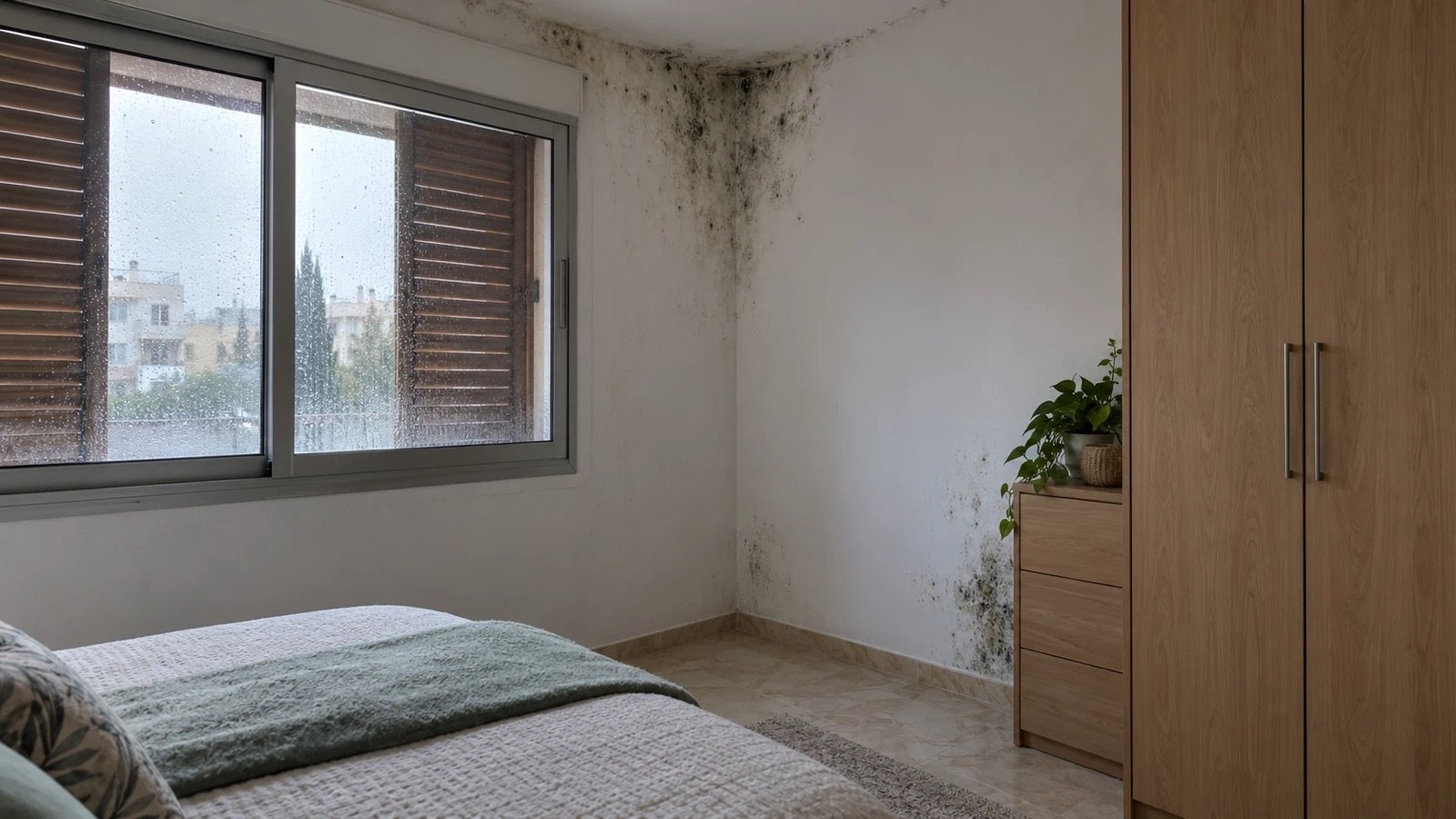
Mould on Walls in Cyprus: Why It Comes Back Every Winter
Why black mould returns to bedrooms, corners and wardrobes every Cyprus winter, how to tell condensation from a leak, what you can do yourself and who to call.
The short answer: winter mould on inside walls is most often condensation. Moisture from cooking, showers and drying laundry settles on walls, corners and windows that are colder than the room. Cleaning removes the mould, not the cause. Add less moisture, let damp air out and keep the coldest rooms from getting too cold. If the mould appears after rain, starts at floor level or keeps coming back whatever you do, look for a leak or a building fault.
Black spots in a bedroom corner, a musty wardrobe, a grey shadow behind the bed. If the same marks return every winter, however well they were cleaned in spring, the house is telling you about moisture and cold surfaces, not about your cleaning.
Our plastering guide covers repairing damp walls. This guide is about the rooms you live in: why the mould keeps coming back, what you can safely do yourself and who to call when that is not enough.
Why does mould come back on Cyprus walls every winter?
Warm indoor air gathers moisture from cooking, showers and drying laundry. When it meets a cold wall, corner or window, it condenses and mould grows.
UK government guidance on damp and mould, updated in April 2026, calls condensation the most common form of damp, and says homes that are not insulated or heated enough are more prone to it. It was written for England, but the physics is the same in Paphos or Nicosia.
Cyprus winters are short but humid. Visit Cyprus, the Deputy Ministry of Tourism's website, describes mild winters from December to February, gives humidity of 65% to 95% on winter days and puts the average January minimum on the central plain at 5°C. Outside walls and windows cool with the weather while the air indoors fills with moisture.
Construction plays its part. As our plastering guide explains, most houses here have a reinforced concrete frame filled in with blocks. The UK guidance also points to cold spots where insulation has gaps, and those are where mould tends to start.
Why is it worst in bedrooms and behind wardrobes?
Bedrooms are often kept cool and closed, and a wardrobe against an outside wall stops warm air reaching it, so that patch of wall stays coldest.
The UK guidance names these exact places: window frames, corners and low points on walls behind sofas or wardrobes. A spare room left shut and unheated all winter gets the moisture that drifts in from the rest of the house but little of the warmth, so its walls reach the dew point, the temperature at which water starts to form, before anywhere else.
Is it condensation, a leak or rising damp?
Condensation mould gathers in cold corners, behind furniture and around windows. Leaks show after rain or near pipes. Rising damp starts low on ground floor walls.
The UK guidance describes four kinds of damp: condensation; penetrating damp, which is water getting in through walls, roofs, windows or floors; rising damp from the ground, often because of a defective damp proof course; and traumatic damp from leaking or burst pipes and overflowing baths or sinks. Where the marks are, and when they get worse, usually tells you which one you have.
| What you see | Most likely cause | What to check first | Who usually fixes it |
|---|---|---|---|
| Black spots in corners, around window frames and behind furniture, worse on cold mornings | Condensation | A humidity reading, how each room is heated and aired, and whether the fans work | You first, then a decorator once the cause is dealt with |
| Water running down the glass and pooling on the sill | Condensation on cold glass or frames | Whether the window has vents and whether they are open | A windows and doors specialist if seals or frames have failed |
| A stain that appears or spreads after rain, often below a flat roof, balcony or cracked render | Penetrating damp | Look again after the next heavy rain, and check gutters and drains | A roofer, or a plasterer for cracked render |
| A tide mark low on ground floor walls, with white salts and bubbling paint | Rising damp | Whether outside ground or paving sits higher than the floor inside | A builder or plasterer who knows older houses |
| A wet patch near a bathroom, kitchen or pipe run that stays wet in dry weather | A leaking pipe | Whether it lines up with a pipe, bath or sink | A plumber |
| A musty smell but no mould you can see | Mould behind furniture, wallpaper or panelling, or under a carpet | Move furniture away from the walls and look behind and underneath | Start with your own check |
Still not sure? The kitchen foil test in our plastering guide tells condensation from water coming through the wall in two days.
Is mould on walls harmful to health?
Damp and mould are linked with breathing problems, allergies and asthma. Children, older people, pregnant women and people with existing health conditions are most at risk.
The World Health Organization's 2009 guidelines on dampness and mould found the most important effects to be more respiratory symptoms, allergies and asthma, plus effects on the immune system, and named the prevention of persistent damp as the best protection. The 2026 UK guidance adds effects on the eyes, skin and mental health, and lists the people most at risk, from those with asthma or lung disease to those with a weakened immune system.
We found no Cyprus Ministry of Health guidance written specifically about damp homes, so this guide relies on WHO and UK government sources. If someone at home has asthma or a lung condition that gets worse in winter, tell their doctor about the mould.
How do I clean mould off a wall safely?
Clean small patches with a mould and mildew product rather than bleach, and let the wall dry fully. Leave large areas to a professional.
This follows the UK guidance, which prefers mould and mildew products to bleach for health and safety reasons and leaves larger areas to qualified professionals.
- Follow the safety instructions on the product label, and keep the room aired while you work.
- Let the surface dry completely before you judge whether it needs repainting.
- Carpets, soft furnishings and other absorbent items that have gone mouldy may have to be thrown away, the guidance warns.
- Photograph the wall and note the date. If the mould is back within weeks, the cause is still there.
Do not paint over mould. Once the cause is fixed and the wall is dry, a decorator can treat the surface and repaint. As our painters and decorators page says, paint on its own brings it back.
How can I stop condensation mould coming back?
Add less moisture, let damp air out and stop the coldest rooms getting too cold. You need all three, every day, through the winter.
Add less moisture
- Cover pans when cooking, and shut internal doors while you cook or shower, as the UK guidance advises.
- Run the extractor fan, or open the window, during a shower and until the mirror clears.
- Dry laundry outdoors when you can. Indoors, use one room with the door shut and a window open or a dehumidifier running.
Let damp air out
Airing works best on cool, dry days. By our calculation, outside air at 10°C and 80% humidity falls to about 42% humidity once it is warmed to 20°C indoors, while mild, muggy air at 15°C and 90% only falls to about 66%. On wet, mild days, lean more on fans and a dehumidifier.
- Keep trickle vents open and clear if your windows have them.
- Use extractor fans where you have them. Many bathrooms in Cyprus have no fan at all, and our bathroom fitters page explains when you need one.
Keep the coldest rooms from getting too cold
- A low, steady heat keeps walls warmer than a short burst of heat in the evening.
- Leave a gap between furniture and outside walls, as the UK guidance recommends.
- Open curtains and blinds during the day so cold windows are not sealed in behind them.
Does a dehumidifier help with mould?
Yes. A dehumidifier pulls water out of the air in a closed or cold room, and the water in its tank shows how much it removed.
It is most useful in a cold bedroom, in the room where laundry dries and in a house shut up between visits. It treats the air, not a leak or rising damp, so if the tank fills every day, keep looking for the source.
What does a humidity reading tell me?
A hygrometer shows the room's relative humidity. The higher the reading, the warmer every wall and window must stay to avoid condensation.
The table shows the dew point for common room conditions: the surface temperature below which water starts to form, rounded to the nearest degree. We worked these figures out with the standard Magnus formula.
| Room temperature | At 50% humidity | At 60% | At 70% | At 80% |
|---|---|---|---|---|
| 16°C | 6°C | 8°C | 11°C | 13°C |
| 18°C | 7°C | 10°C | 12°C | 14°C |
| 20°C | 9°C | 12°C | 14°C | 16°C |
| 22°C | 11°C | 14°C | 16°C | 18°C |
So a bedroom at 18°C and 70% humidity will grow water on any surface colder than about 12°C. At 50% humidity the danger point falls to about 7°C. A digital hygrometer in the worst room shows whether your changes are working.
When should I call a tradesperson about mould?
Call a tradesperson if mould returns soon after cleaning, appears after rain, starts at floor level, or keeps growing despite good ventilation and heating.
Match the trade to the cause, not to the stain:
- Painters and decorators treat the surface and repaint once the cause is dealt with. Decorators listed on TrustedTradesCyprus include Fine Finish Property Maintenance in Paphos, whose listing also covers water leak repairs and flat roof waterproofing, and Prodec Painting and Maintenance Contractors in Limassol. See all painters and decorators in Cyprus.
- Bathroom fitters add or replace extractor fans and sort out bathrooms with no ventilation.
- Window and door specialists fix failed seals, frames that run with water and windows with no vents.
- Roofers trace and fix leaks from flat roofs, balconies and gutters.
- Plasterers replace plaster that has blown or filled with salts, and repair cracked render that lets rain in.
- Plumbers find and repair leaking pipes in walls and floors.
- Builders in Paphos, Limassol and across Cyprus take on the bigger fixes, such as insulating cold walls or dealing with rising damp in older houses.
Our quote comparison tool helps you weigh two or three quotes for the same job, and the directory lists every trade by area.
What should a tradesperson check before quoting?
They should look for the cause first: where the mould sits, the roof, gutters, render, windows and fans, and how you heat and air the home.
A quote from someone who has looked at none of that only prices the symptom. Ask:
- What do you think is causing it, and how have you ruled out a leak?
- What will you do about the cause, not just the surface?
- Which product will you use on the mould, and which paint afterwards?
- Does the price include moving furniture, protecting floors and cleaning up?
- What happens if the mould comes back in the same place this winter?
Be wary of anyone who offers to paint over mould without asking about ventilation or leaks. For a bigger job, our guide on how to check a builder in Cyprus covers the checks to make before you hire.
What affects the cost of fixing mould for good?
It depends on the cause. Cleaning and repainting is one cost; fixing the fan, window, roof leak or cold wall behind it is another.
We do not publish prices for this work because they depend so much on the house. Ask for a written quote that lists each of these separately, so that quotes can be compared line by line:
- How many rooms, and how much wall and ceiling area, need treating and repainting.
- Whether the plaster underneath is sound or has to be cut out and replaced.
- The fix for the cause: a new or better extractor fan, window seals or vents, roof, balcony or gutter repairs, a pipe repair or insulation.
- Access, such as scaffolding for outside walls or work on a flat roof.
- The products named in the quote, from the mould treatment to the paint.
- Moving furniture, protecting floors and making good afterwards.
If insulating cold walls is part of the answer, our plastering guide explains the Save and Upgrade Homes 2026 grant, which includes thermal insulation among its eligible measures. Check the official call before you commit to any work.
Holiday homes, rented homes and new builds
A house shut between visits has no showers or cooking adding moisture, but no heating or airing either, so mould can still take hold. Our guide to property maintenance while you live abroad covers what a key holder should do through the winter.
If you rent, tell your landlord in writing as soon as mould appears, with dated photos of each patch. In a new build, report it to the developer in writing straight away. Poor bathroom ventilation is one of the issues our snagging guide covers.
Frequently asked questions
Why does a room smell musty when I cannot see any mould?
It can mean mould behind furniture, wallpaper or panelling, or under a carpet, as UK guidance notes. Check those places first, then call a tradesperson.
Does mould go away on its own in summer?
It usually stops growing once the house warms and dries out, but the stains and the cause stay, so it returns with the first cold weeks.
Sources
- WHO guidelines for indoor air quality: dampness and mould, World Health Organization, 2009
- Understanding and addressing the health risks of damp and mould in the home, UK government (OHID, DHSC, MHCLG and UKHSA), updated 1 April 2026
- Climate and weather, Visit Cyprus, Deputy Ministry of Tourism
- Save and Upgrade Homes Grant Scheme 2026, Cyprus funding programmes portal
- Dew point and humidity figures: TrustedTradesCyprus calculation with the Magnus formula, using the coefficients published by Alduchov and Eskridge (1996) in the Journal of Applied Meteorology
Find a decorator near you
Browse painters and decorators and the other trades in this guide, compare services and coverage, and check verification details before you build your shortlist. Quotes from the tradespeople are free: tell us about the job and we’ll help find a suitable one.
Get free quotesFind a decoratorList your business